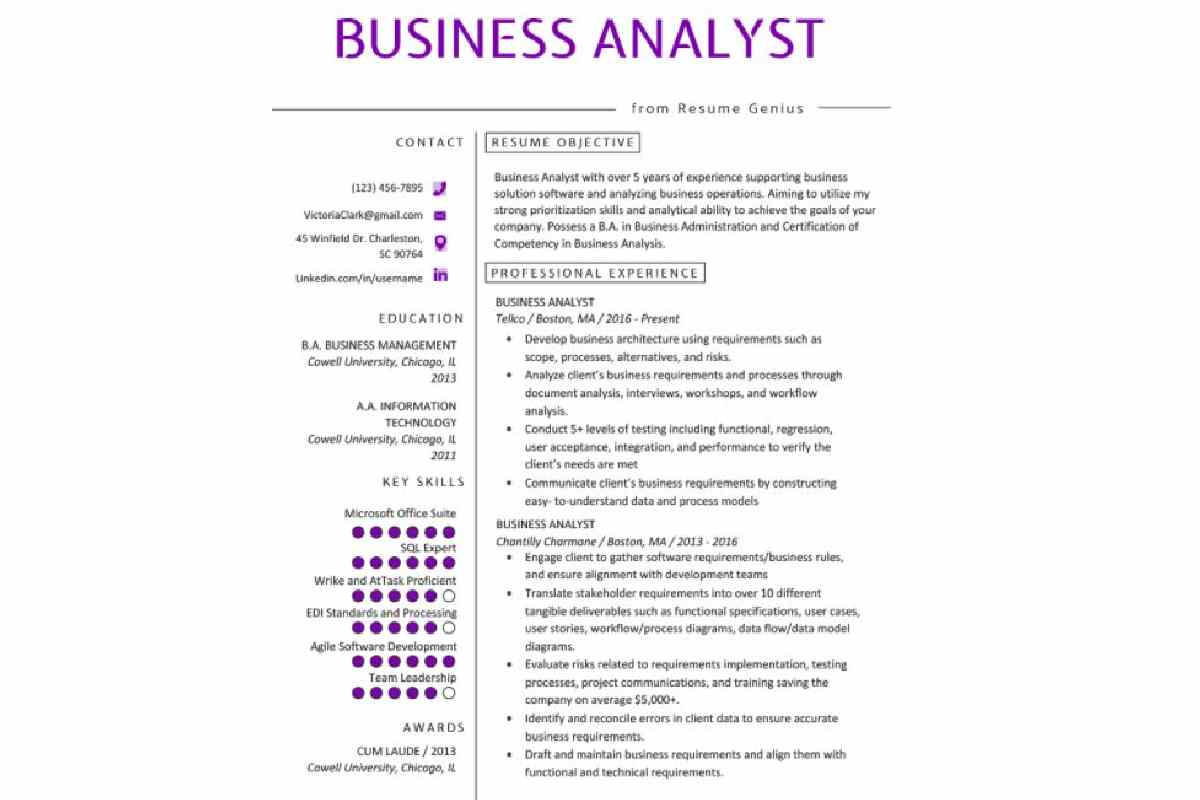
A resume of a business analyst is not a list of tools and credentials and former job titles. It is a narrative of how you learn business issues and how you translate them into informative projections and assist organisations to make sound judgments. However, having a resume that does not pass the test of many business analysts is the reason why they are only read like a generic job description rather than supported arguments.
Unless you have ever been turning in applications to dozens of positions and not gotten a reply, it is not likely that the problem is that you do not have experience. It is the way that experience is framed. It is a step- by- step dissection of how to create a business analyst resume that would be attractive to recruiters, hiring managers, and applicant tracking systems (ATS) without making it stilted and unnatural.
Table of Contents
About Business Analyst
(Experienced)
Results-driven Business Analyst with strong experience in gathering and analyzing business requirements, improving processes, and delivering data-driven solutions. Skilled in working with cross-functional teams, translating stakeholder needs into functional specifications, and supporting Agile and Waterfall projects. Proficient in SQL, Excel, Power BI, and Jira, with a proven ability to improve efficiency, reduce costs, and support strategic decision-making.
(Mid-Level)
Detail-oriented Business Analyst with hands-on experience in requirement elicitation, documentation, and data analysis. Adept at collaborating with stakeholders, creating BRDs and user stories, and supporting UAT activities. Strong analytical and communication skills with a focus on delivering business value through process optimization and clear insights.
(Fresher / Entry-Level)
Motivated Business Analyst graduate with a solid foundation in business analysis concepts, data analysis, and documentation. Experienced in academic and practical projects involving requirement gathering, SQL analysis, and dashboard creation. Strong problem-solving skills with a passion for converting data into actionable business insights.
Short & ATS-Friendly Version
Business Analyst with expertise in requirements gathering, stakeholder management, data analysis, and process improvement. Experienced in Agile methodologies, SQL, Excel, and data visualization tools to support informed business decisions.
What Hiring Managers Look for in a Business Analyst Resume
Before writing anything, it helps to understand how your resume is actually read. Most business analyst resumes go through three filters. First, an ATS scans it for keywords. Next, a recruiter spends about 6–10 seconds skimming it. Only then does a hiring manager read it carefully.
The managers who are hiring are not seeking a person who is familiar with Excel or worked on dashboards. They desire evidence that you are capable of analytical communication and result execution. There are three questions that should be answered by your resume:Can this person understand business needs?
- Can they turn data into insights?
- Can they communicate clearly with stakeholders?
If your resume doesn’t signal these points quickly, it won’t move forward.
Key Skills Section
Here’s a well-structured “Key Skills” section in table format, perfect for a Business Analyst resume and fully ATS-friendly:
| Skill Category | Key Skills |
| Business Analysis | Requirements Gathering, BRD, FRD, Use Cases, User Stories, Gap Analysis |
| Stakeholder Management | Client Communication, Workshops, Requirement Elicitation |
| Process Improvement | AS-IS / TO-BE Analysis, Process Mapping, Business Process Re-engineering |
| Data Analysis | SQL Queries, Data Validation, Trend Analysis |
| Reporting & Visualization | Power BI, Tableau, Dashboards, KPI Tracking |
| Documentation | Functional Specs, SOPs, Confluence, MS Word |
| Agile & SDLC | Agile Scrum, Kanban, Waterfall, SDLC |
| Testing & UAT | Test Case Creation, UAT Support, Defect Tracking |
| Tools & Software | Jira, Excel (Pivot Tables, VLOOKUP), Visio |
| Analytical Skills | Critical Thinking, Root Cause Analysis |
| Communication Skills | Presentation, Negotiation, Cross-functional Collaboration |
| Problem Solving | Risk Analysis, Solution Evaluation |
| Domain Knowledge | Banking, Healthcare, E-commerce, IT/SaaS (as applicable) |
Ideal Structure of a Business Analyst Resume
A strong business analyst resume follows a clean, logical structure. It doesn’t overload the reader, and it doesn’t bury key information.
Recommended Resume Sections
| Resume Section | Purpose |
| Header | Name, job title, contact details |
| Professional Summary | Snapshot of experience and value |
| Core Skills | Tools, methodologies, and competencies |
| Work Experience | Impact-focused role descriptions |
| Education | Degree and relevant coursework |
| Certifications | Optional but valuable |
| Projects | Especially useful for freshers or career switchers |
This structure works well for both experienced professionals and entry-level candidates, with minor adjustments.
Writing a Strong Professional Summary
The professional summary is often the most ignored yet most important part of a business analyst resume. Many summaries sound like this:
“Detail-oriented business analyst with experience in data analysis and stakeholder management.”
This tells the reader nothing unique. A good summary should reflect your level, domain exposure, and measurable impact.
Sample of a Good Business Analyst Resume.
Outcome-oriented Business Analyst who has gathered 5 or more years of experience in converting intricate business needs to data-based solutions. Demonstrated success in enhancing operational efficiency, streamlining reporting procedures and working as part of cross-functional teams to provide guidance to strategic decision making.
This works as it is understandable, assertive, and result-driven, without coming out as far-fetched.
Essential Skills: What and How to Show.
The skills section must not substitute the experience. It will be of no use to list 30 tools when not applied in your work history..
A clean, categorized skills section is easier to scan and more ATS-friendly.
Business Analyst Skills Table
| Category | Skills |
| Business Analysis | Requirement gathering, BRD, FRD, GAP analysis |
| Data & Analytics | Data analysis, data validation, SQL, Excel |
| Visualization | Reports, Dashboards, data storytelling |
| Tools | JIRA, Power BI, Confluence, Tableau |
| Methodologies | Agile, Scrum, Waterfall |
| Soft Skills | Stakeholder communication, problem-solving |
Keep this list honest. If you can’t comfortably discuss a skill in an interview, don’t include it.
How to Write Business Analyst Work Experience That Stands Out?
This is where most resumes fail. Business analysts often copy-paste responsibilities instead of showing impact. Recruiters want to see what changed because you were there.
Instead of writing what you were “responsible for,” focus on what you did and improved.
Weak Example
- Responsible for requirement gathering and documentation
- Created reports for stakeholders
Strong Example
- Led requirement gathering sessions with cross-functional stakeholders, resulting in a 20% reduction in rework
- Designed and delivered automated dashboards that reduced manual reporting time by 30%
See the difference? One sounds passive. The other sounds valuable.
Tools & Technologies
Here’s a clean, professional “Tools & Technologies” table you can directly add to a Business Analyst resume:
| Category | Tools & Technologies |
| Business Analysis | BRD, FRD, Use Cases, User Stories, Gap Analysis |
| Data Analysis | SQL, Microsoft Excel (Pivot Tables, VLOOKUP, Macros) |
| Data Visualization | Power BI, Tableau, Google Data Studio |
| Project Management | Jira, Trello, Asana |
| Documentation | MS Word, Confluence, Google Docs |
| Process Modeling | MS Visio, Lucidchart, Draw.io |
| Methodologies | Agile (Scrum, Kanban), Waterfall, SDLC |
| Databases | MySQL, PostgreSQL, SQL Server |
| Reporting Tools | Power BI Reports, Excel Dashboards |
| Collaboration Tools | Microsoft Teams, Slack, Zoom |
| Version Control | Git, GitHub |
| Testing & UAT | Test Cases, UAT Planning, Defect Tracking |
| Automation (Basic) | Excel VBA, Power Automate |
| Cloud Platforms (Basic) | AWS, Microsoft Azure |
Resume Tips for Business Analysts
Here’s a clear, ATS-friendly “Resume Tips for Business Analysts” table you can directly include in your content or resume guide:
| Resume Area | Best Practice Tips for Business Analysts |
| Professional Summary | Keep it to 3–4 lines; highlight experience, domain knowledge, and key tools |
| Keywords & ATS | Use job-description keywords like BRD, FRD, SQL, Agile, UAT |
| Achievements | Quantify results (e.g., reduced costs by 20%, improved efficiency by 30%) |
| Skills Section | Separate Business, Technical, and Tools skills for clarity |
| Experience Section | Use action verbs: Analyzed, Led, Optimized, Implemented |
| Projects (Freshers) | Add real-world or academic projects with measurable outcomes |
| Formatting | Use clean fonts, bullet points, and consistent spacing |
| Length | 1 page for freshers, 1–2 pages for experienced professionals |
| Customization | Tailor the resume for each job role and industry |
| Tools & Technologies | List tools relevant to the role; avoid outdated technologies |
| Certifications | Include recognized BA, Agile, or analytics certifications |
| Soft Skills | Highlight communication, problem-solving, and stakeholder management |
| Grammar & Clarity | Avoid jargon overload; keep sentences concise and clear |
| Design | Keep design simple; avoid heavy graphics that confuse ATS |
| File Format | Save and submit as PDF unless Word format is requested |
Experience Section Format That Works
Use this format consistently across roles:
Job Title – Company Name
Location | Duration
Follow with 3–6 bullet points focused on outcomes, not duties.
Business Analyst Experience Example
| Element | Example |
| Role | Business Analyst |
| Duration | Jan 2021 – Present |
| Focus | Process improvement, reporting, stakeholder alignment |
| Outcome | Improved efficiency, better decision-making |
Avoid long paragraphs. White space improves readability and keeps recruiters engaged.
Projects Section: Especially Important for Freshers
If you’re a fresher or switching careers, projects can carry your resume. A well-written project section shows initiative and applied knowledge.
How to Present Business Analyst Projects
| Project Detail | Description |
| Project Title | Sales Performance Analysis |
| Objective | Identify revenue trends and bottlenecks |
| Tools Used | Excel, SQL, Power BI |
| Outcome | Improved sales forecasting accuracy |
Even academic or self-initiated projects are valid if explained clearly.
Education Section: Keep It Simple and Relevant
For most business analyst roles, education matters less than experience. Still, it should be clean and concise.
Mention your degree, institution, and year of completion. Add relevant coursework only if you are a fresher.
Education Format Example
| Degree | Institution | Year |
| BBA / B.Tech / B.Com | University Name | 2019 |
Avoid adding unnecessary personal details here.
Business Analyst Resume: Key Sections Explained With Examples
A business analyst resume works best when information is structured, scannable, and evidence-based. Recruiters don’t read every word—they skim tables, headings, and metrics. That’s why using tables thoughtfully can improve clarity without hurting ATS performance.
Business Analyst Resume Overview
| Resume Aspect | What Recruiters Expect |
| Focus | not job duties, Business impact |
| Keywords | Business analysis, data, stakeholders |
| Metrics | Numbers that show results |
| Length | 1–2 pages |
| Tone | Professional, clear, outcome-driven |
A good resume quickly shows what problem you solved and how the business benefited.
Professional Summary Table (Examples)
Your summary should change based on experience level.
| Experience Level | Sample Professional Summary |
| Fresher | Entry-level Business Analyst with strong analytical skills and hands-on project experience in requirement gathering, data analysis, and reporting. Adept at translating business needs into clear documentation and actionable insights. |
| Mid-Level | Business Analyst with 4+ years of experience supporting data-driven decision-making through requirement analysis, dashboard reporting, and stakeholder collaboration across multiple business functions. |
| Senior | Senior Business Analyst with 8+ years of experience leading enterprise-level initiatives, optimizing business processes, and delivering measurable operational and financial improvements. |
Core Skills Section in Table Format
Grouping skills makes your resume easier to scan and more ATS-friendly.
| Skill Category | Skills |
| Business Analysis | Requirement gathering, BRD, FRD, use cases, gap analysis |
| Data & Reporting | Data analysis, data validation, Excel, SQL |
| Visualization | Power BI, Tableau, dashboard creation |
| Tools | JIRA, Confluence, MS Visio |
| Methodologies | Agile, Scrum, Waterfall |
| Soft Skills | Stakeholder communication, problem-solving, documentation |
Only include skills you can confidently explain in interviews.
Work Experience: Responsibility vs Impact
Recruiters prefer impact statements over generic responsibilities.
| Weak Resume Line | Strong Resume Line |
| Responsible for gathering requirements | Conducted requirement-gathering sessions with stakeholders, reducing scope creep by 25% |
| Created reports | Developed automated reports that cut manual reporting time by 30% |
| Worked with teams | Collaborated with cross-functional teams to improve process efficiency |
Business Analyst Work Experience Format
Use a consistent, structured format.
| Section Element | What to Include |
| Job Title | Business Analyst |
| Company | Organization name |
| Duration | Month & year |
| Key Focus | Domain or function |
| Achievements | Measurable outcomes |
Example Experience Entry
| Detail | Description |
| Role | Business Analyst |
| Company | XYZ Solutions |
| Duration | Jan 2021 – Present |
| Key Achievements | Improved reporting accuracy by 20% through data validation and automation |
Projects Section (Very Important for Freshers)
Projects show applied skills, especially if work experience is limited.
| Project Element | Example |
| Project Title | Customer Churn Analysis |
| Objective | Identify factors influencing customer attrition |
| Tools Used | Excel, SQL, Power BI |
| Outcome | Improved retention strategy recommendations |
Academic and self-learning projects are completely acceptable when explained clearly.
Avoid unnecessary details like marks unless explicitly required.
Certifications Table
Certifications add value but should not dominate your resume.
| Certification | Issuing Body | Status |
| Business Analysis Fundamentals | Online Platform | Completed |
| Agile Scrum Basics | Training Institute | Completed |
| Data Analytics Certification | Online Platform | Ongoing |
ATS Optimization Checklist Table
| ATS Factor | Best Practice |
| File Format | PDF or DOCX |
| Keywords | Match job description naturally |
| Headings | Use standard titles |
| Graphics | Avoid icons and images |
| Tables | Use simple, clean tables |
Common Business Analyst Resume Mistakes
| Mistake | Why It Reduces Shortlisting |
| Too many tools listed | Looks unfocused |
| No numbers or metrics | Weak impact |
| Long paragraphs | Hard to skim |
| Generic descriptions | Blends with other resumes |
| Irrelevant experience | Dilutes core profile |
Resume Length Guidelines
| Experience Level | Ideal Length |
| Fresher | 1 page |
| 2–5 years | 1–2 pages |
| 6+ years | 2 pages |
Quality matters more than quantity.
Certifications: Do They Really Matter?
Certifications won’t replace experience, but they can strengthen your profile—especially for junior roles.
Commonly valued certifications include:
- Business analysis foundations
- Agile or Scrum certifications
- Data analytics or visualization certifications
Only include certifications you’ve completed or are actively pursuing.
ATS Optimization Tips for Business Analyst Resumes
An ATS-friendly resume doesn’t mean keyword stuffing. It means natural alignment with job descriptions.
Here’s what helps:
- Use standard section headings
- Avoid graphics and tables for critical information
- Mirror keywords from job postings naturally
- Save your resume as a PDF or Word file
A resume that reads well to humans will usually perform well in ATS too.
Common Business Analyst Resume Mistakes to Avoid
Many good candidates get rejected for avoidable reasons.
| Mistake | Why It Hurts |
| Generic summaries | Fails to differentiate you |
| Too many tools | Looks unfocused |
| No metrics | Weakens credibility |
| Long paragraphs | Hard to scan |
| Irrelevant experience | Dilutes your core value |
Fixing these alone can significantly improve callback rates.
Resume Length: How Long Is Too Long?
For most business analysts:
- 1 page works for freshers and junior roles
- 2 pages are acceptable for experienced professionals
Having a resume longer than two pages, time to cut is now past repetition and not content.
Conclusions: How to write your resume like a business analyst.
Your business analyst resume must demonstrate your way of thinking in the job. Presentation, logicality, data that is relevant and results which are measurable. What you are not simply doing is adding experience to the list but you are analyzing your own career and offering insights.