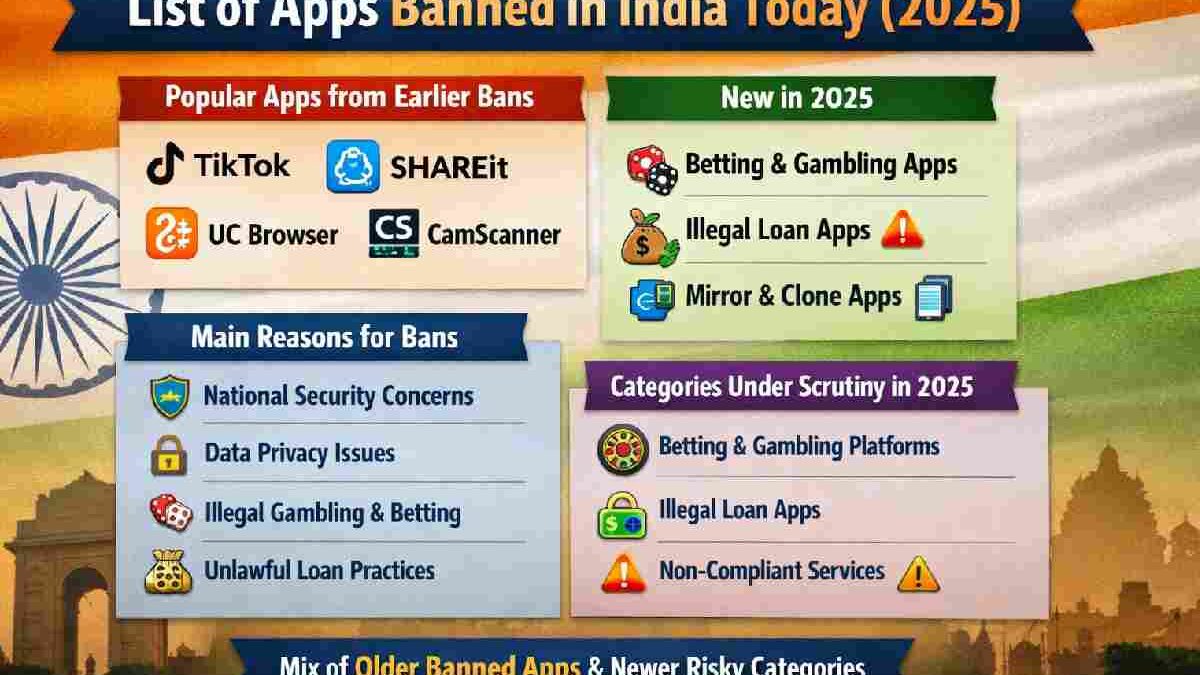
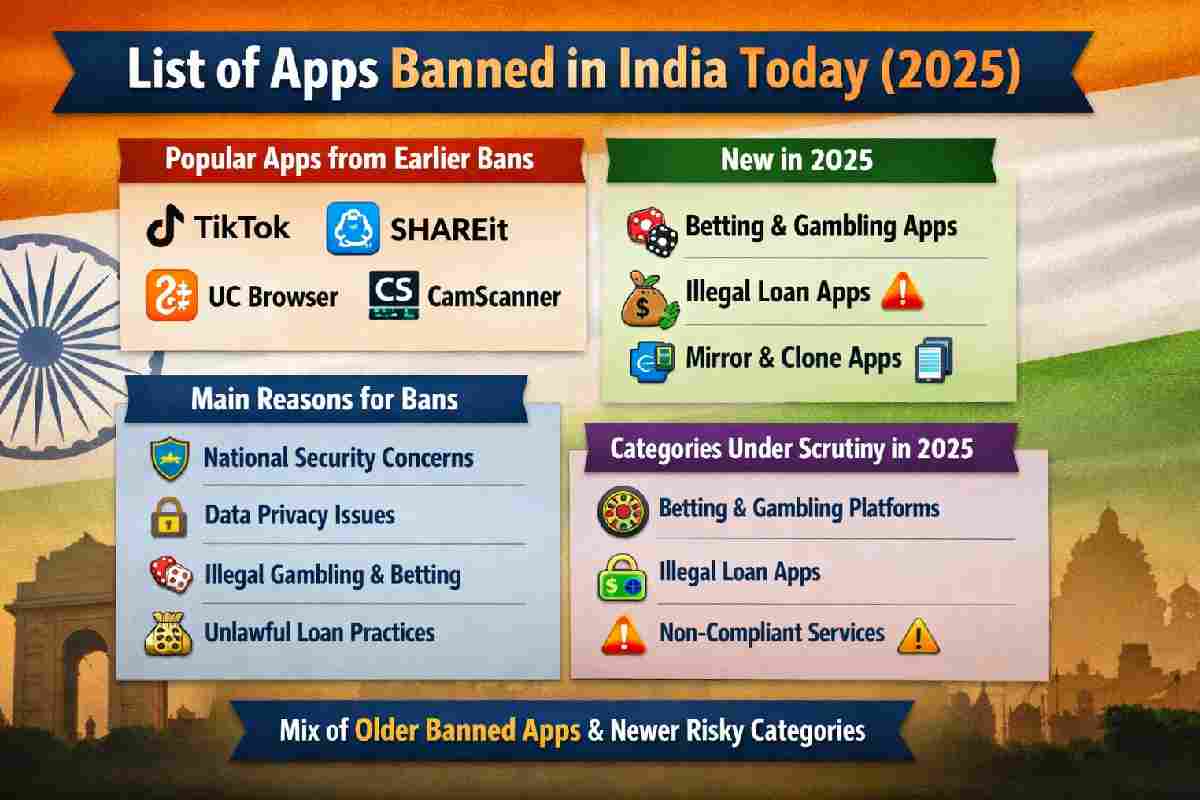
List of Apps Banned in India Today (2025) – If you are searching for the list of apps banned in India today in 2025, it helps to understand one important thing first: India does not always maintain one single public “live” list that updates like a scoreboard. In many cases, app blocking happens through government orders, platform takedowns, or category-based enforcement under Indian law. That is why people often see different lists online.
The most reliable way to talk about banned apps in India is to separate them into two groups: well-known officially blocked apps from earlier government orders and apps or platforms newly blocked in 2025 under gambling, betting, security, or illegal lending enforcement.
In plain words, the term “banned apps in India” usually refers to apps that have been blocked under Section 69A of the Information Technology Act, 2000, often for reasons such as national security, sovereignty, public order, data safety, or illegal activity. That is the legal backbone behind many of India’s most discussed app bans.
This guide gives you a human-friendly, blog-style overview of the topic for 2025. It is designed to be useful for readers, students, bloggers, and general users who want clarity without wading through confusing or recycled lists.
Table of Contents
What Does “Apps Banned in India” Actually Mean?
When people hear that an app is banned in India, they often imagine that the app has vanished everywhere forever. In reality, the situation is usually more nuanced.
A banned or blocked app in India can mean:
| Term | What it usually means |
| Blocked app | Access is restricted for users in India through official action |
| Removed from app stores | The app may be taken down from Google Play or Apple App Store for Indian users |
| Website/app access restricted | The app’s services, domains, or associated links may be blocked |
| Category-based crackdown | Entire classes of apps, such as illegal betting or loan apps, may face enforcement |
So, when someone asks for the list of banned apps in India today in 2025, they are often asking for a mix of older famous bans and newer enforcement actions.
Why India Bans Apps
India’s app bans are not random. The government has repeatedly cited concerns tied to national security, sovereignty, defense, public order, data privacy, illegal gambling, and unlawful financial activity. The 2020 app crackdown became the most famous example, but by 2025, enforcement had also expanded into areas like online betting/gambling and illegal loan lending apps.
Common reasons apps get blocked in India
| Reason | Explanation |
| National security concerns | The app is seen as posing risk to India’s sovereignty or security |
| Data privacy concerns | Sensitive user data may be collected or transferred improperly |
| Public order issues | Authorities may view the app as harmful to social stability or law and order |
| Illegal gambling or betting | Apps promoting unregulated betting or gaming face action |
| Illegal financial practices | Loan apps accused of predatory or unlawful conduct may be blocked |
This is why many banned-app discussions in India go beyond social media. The story now includes shopping apps, gaming apps, betting apps, finance apps, and utility apps too.
The Big Background: The Famous 2020 App Ban
Any article on banned apps in India still starts here, because this was the turning point.
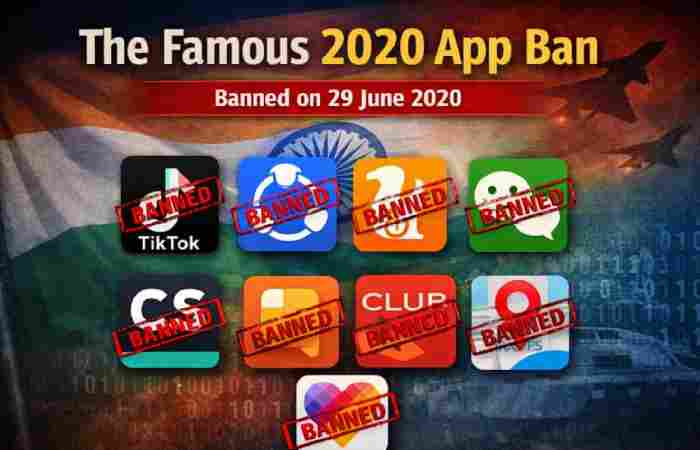
On 29 June 2020, the Government of India announced a ban on 59 mobile apps under Section 69A, saying they were prejudicial to India’s sovereignty and integrity, defense, security of state, and public order. This became one of the biggest digital-policy actions in India’s recent history.
Some of the most recognized names from that order included:
| Popular apps from the 2020 ban | Category |
| TikTok | Short video |
| SHAREit | File sharing |
| UC Browser | Web browser |
| Likee | Short video/social |
| Helo | Social/content |
| Messaging | |
| Club Factory | Shopping |
| CamScanner | Document utility |
| Xender | File sharing |
| Baidu Maps | Maps/navigation |
These names still dominate search results because they were widely used before the ban. For many Indian users, this is what they remember when they hear “banned apps.”
Other Officially Blocked Apps from Later Government Orders
The 2020 list was not the end. The government later blocked additional apps in separate waves. One notable official order in November 2020 blocked 43 mobile apps.
Some names from that later wave included:
| Examples from later official blocking action | Category |
| AliExpress | E-commerce |
| Snack Video | Short video |
| CamCard | Business utility |
| Lalamove India | Delivery/logistics |
| Alibaba Workbench | Business/e-commerce |
| Alipay Cashier | Payments |
| Soul | Social/dating |
This matters for 2025 readers because many websites still publish only the first famous 59-app list and forget that enforcement continued later.
Banned Apps in India in 2025: What Changed?
By 2025, the conversation had shifted.
Instead of only talking about old Chinese apps, policy attention also focused heavily on online betting, gambling, gaming-related services, and illegal lending apps. According to a 26 March 2025 PIB release, MeitY had issued 1,410 blocking directions related to online betting, gambling, and gaming websites between 2022 and 2025. That shows the crackdown was no longer limited to a one-time app ban story. It had become a wider digital enforcement pattern.
In another 2025 government note, it was stated that between 2022 and June 2025, 1,524 betting and gambling websites and mobile apps were blocked.
That is a big clue for anyone searching this topic: in 2025, many “banned apps” were not just mainstream social apps. A large portion of enforcement was aimed at illegal betting and gambling ecosystems.
Examples of App Categories Under Scrutiny in 2025
Here is a more realistic table for 2025 readers:
| App category | Status trend in India by 2025 | Why it matters |
| Old Chinese-origin apps from 2020 waves | Many remained blocked or restricted | National security and data concerns |
| Betting and gambling apps | Heavy enforcement and blocking | User protection, illegal wagering concerns |
| Illegal loan apps | Tightening scrutiny | Harassment, predatory lending, unlawful recovery practices |
| Non-compliant platforms | Risk of takedown or access restrictions | Legal and regulatory violations |
| App clones and mirror versions | Often appear after bans | Users may mistake them for legal replacements |
This is why simply searching “banned apps list 2025” can be misleading. The ecosystem is dynamic. Some apps disappear, some return under altered branding, and some clones show up to exploit users.
A Practical List: Well-Known Apps Commonly Included in India’s Banned-App Discussions
Below is a reader-friendly reference table of names commonly associated with India’s major app blocking history. This is not a claim that every one of these is a newly banned app in 2025; rather, these are the most recognized names people usually mean when they search the topic.
| App name | Type | Why it became notable |
| TikTok | Short video | One of the biggest social video bans in India |
| SHAREit | File transfer | Widely used before ban wave |
| UC Browser | Browser | Very popular mobile browser in India |
| Helo | Social/content | Large vernacular audience before restrictions |
| Likee | Short video | Competitor in the short-video space |
| Messaging | Chinese messaging and super-app ecosystem | |
| CamScanner | Productivity | Popular scanning app before being blocked |
| Xender | File sharing | Common offline file-sharing app |
| Club Factory | Shopping | Known for low-cost e-commerce |
| AliExpress | Shopping | Major cross-border marketplace |
| Snack Video | Short video | Became widely discussed after later ban wave |
| Baidu Maps | Navigation | Chinese mapping app |
| QQ Mail | Part of Tencent ecosystem | |
| Social media | Chinese microblogging platform | |
| Bigo Live | Live streaming | Social live-content platform |
This kind of table works well in a blog because it gives readers quick recognition without pretending there is one magical “all apps banned today” spreadsheet openly maintained in real time.
Are There Newly Banned Apps in 2025?

Yes, but here is the nuance: for 2025, public reporting and government statements point strongly toward continued action against betting, gambling, and unlawful apps, rather than only a famous headline list of social apps. For example, media reports in 2025 mentioned apps such as Winaura, Winstler42, Casinohermes, Amunra1, and Polymarket in the context of gambling-related bans or enforcement discussions, while government communications emphasized the much broader scale of blocking directions in this area.
Because of that, a careful article should avoid overclaiming that there is one final, complete, official 2025 public master list available everywhere. A more honest view is this:
India in 2025 is actively blocking categories of apps and services, especially illegal betting/gambling platforms, while the famous earlier app bans remain the most recognized public reference point.
Sample 2025 Category Table for Readers
| 2025 banned-app discussion area | What readers should know |
| Chinese-origin apps from old waves | These remain part of the public memory and many are still treated as banned/restricted references |
| Betting apps | This is one of the biggest enforcement areas in 2025 |
| Gambling websites and mobile apps | Government statements show large-scale blocking action |
| Illegal loan apps | Stronger scrutiny continues because of consumer harm concerns |
| Mirror apps or unofficial APKs | These may be risky, unsafe, or unlawful to use |
This kind of structure helps your article feel updated instead of sounding like a copy-paste from 2020.
Why So Many Websites Show Different Lists
This confuses readers all the time, and honestly, the confusion is understandable.
There are three main reasons:
- Old and new enforcement get mixed together
Many websites combine the 2020 social-media app bans with later actions on e-commerce, gambling, and financial apps.
- Some lists are unofficial compilations
A blog may present a “complete list,” but it often merges government orders, media reports, mirror apps, and app-store removals.
- Bans are not always published as one simple live tracker
The government may issue blocking directions and category-based enforcement without maintaining a single consumer-friendly page that everyone can read like a daily updated list.
So when users ask, “Which apps are banned in India today in 2025?” the best answer is not just a raw list. The best answer is an explained list.
How to Check Whether an App Is Banned or Risky in India
Here is a practical user-first table:
| Checkpoint | Why it helps |
| Is the app missing from official app stores in India? | It may indicate restriction or removal |
| Has the government or PIB reported blocking action? | This is a stronger signal than random blogs |
| Is the app linked to betting, gambling, or loan scams? | These categories face high scrutiny |
| Is the app only available as an APK from unknown sites? | This raises safety and legality concerns |
| Does the app ask for excessive permissions? | It may create privacy or financial risks |
A lot of users end up downloading “replacement” APKs after a ban. That is often where the bigger danger begins. Even when curiosity is understandable, random APK files can expose the device to malware, data theft, or scams.
Is It Illegal for Users to Have a Banned App?
This is one of the most searched questions around the topic.
The enforcement framework mainly targets access blocking and intermediary compliance, rather than turning ordinary users into the main target. Still, using blocked or unofficial versions of apps can create serious problems at the level of security, payments, privacy, and compliance. A safer takeaway is not to chase banned apps through unknown sources. The legal picture may differ by context, but the practical risks are often immediate. Government blocking orders under Section 69A are primarily directed at access and compliance mechanisms.
Popular Alternatives After App Bans in India
One reason app bans became such a huge public topic is that users immediately looked for alternatives.
| Banned app example | Users often moved to alternatives like |
| TikTok | Instagram Reels, YouTube Shorts, Moj, Josh |
| SHAREit / Xender | Nearby Share-style tools, cloud storage, platform-native sharing |
| UC Browser | Chrome, Firefox, Brave, Edge |
| CamScanner | Adobe Scan, Microsoft Lens, built-in scan tools |
| Club Factory / AliExpress | Amazon, Flipkart, Myntra, local sellers |
This shift also helped Indian and global competitors gain ground after major bans.
What This Means for Bloggers, Students, and SEO Writers
If you are writing on “list of apps banned in India today 2025”, the strongest approach is to avoid sounding robotic or overly certain about a single giant “live list.” Readers trust content more when it does three things:
- Explains the legal basis
- Separates historic high-profile app bans from 2025 category-based crackdowns
- Gives a clean table of examples instead of pretending to know every blocked app in real time
That style feels more human, more responsible, and honestly, more useful.
Quick Summary Table
| Topic | Key takeaway |
| Legal basis | Many app blocks are issued under Section 69A of the IT Act |
| Famous ban wave | 59 apps were blocked in June 2020 |
| Later action | Another 43 apps were blocked in November 2020 |
| 2025 trend | Betting, gambling, and risky financial apps saw major enforcement |
| User advice | Avoid mirror APKs and check reliable sources before downloading anything |
Final Thoughts
The list of apps banned in India today in 2025 is not just a nostalgic TikTok-era search anymore. It now reflects a much broader digital-policy story. Yes, the famous banned names like TikTok, UC Browser, SHAREit, CamScanner, Xender, and AliExpress still dominate public memory. But in 2025, the bigger enforcement pattern includes online betting, gambling platforms, and suspicious digital services as well.
So the most accurate and reader-friendly answer is this: India’s banned-app landscape in 2025 is a mix of older officially blocked apps and newer category-based crackdowns. That is why different websites show different lists, and that is also why smart readers should focus on official sources, app-store availability, and safety signals rather than random APK links.