
Avid Media Composer refers to a professional non-linear editing (NLE) software that is designed to operate in post-production at scale volume (ideally long) and collaboratively (i.e. feature film, episodic TV, broadcast, and enormous commercial work). It was developed with the consideration of a ground-up design of editors with large media libraries, complex media format, and multi-user workflows where reliability, precision, and media control are the most important.
Two short, practical bullet points:
- Potential: great media management and collaborative work among multi-users in regard to massive projects.
- Trade-off: learner SH CSH, more workflow rigidity is characterized than consumer-friendly NLEs.
(Recent Avid releases keep updating to keep up with modernisation of workflow, as well as introducing AI-supported features such as smarter transcripts and proxy/high-res linking; the product pages of Avid are listing these continuing enhancements.)
Table of Contents
Who uses Media Composer (and why)?
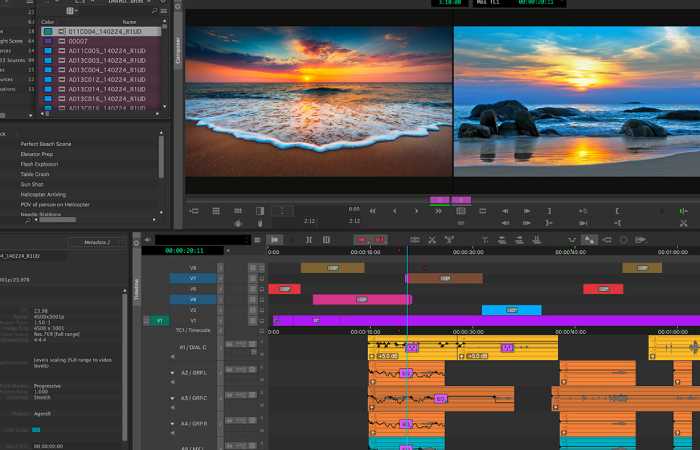
- Feature-film and TV editors who need robust media tracking, frame-accurate trimming, and project locking tools.
- Broadcast houses and newsrooms that value stability and integration with editorial and audio finishing systems.
- Post-production teams requiring shared storage, permissions, and collaboration features.
- Editors moving between broadcast and finishing — Media Composer’s ecosystem ties well into grading and audio stages used in professional film pipelines.
A quick human note: Media Composer is less about “fast YouTube edits” and more about repeatable, defensible, team-friendly workflows. If your daily work involves dozens to hundreds of hours of footage, multiple assistants, and deliverables for many formats — Media Composer stays calm under that pressure.
What’s new/important in recent releases
Incremental releases with specific features Avid has been issuing incremental updates of its software, as above, with improved transcript workflows, speech-to-text, improved proxy/high-res linking to enable fast conform and playback, and collaboration tools to reduce friction between editorial and audio department. The purpose of these updates is to introduce part of the convenience that modern editors desire and maintain the enterprise-level backbone.
The core strengths — practical breakdown
1. Media and project management (killer feature)
Media Composer’s bin structure, AMA/OP-Atom linking, and experience with shared storage (Avid NEXIS, third-party SANs) is built for multi-editor environments. When media must be tracked, relinked, and handed off, Media Composer is purpose-built for that lifecycle.
2. Precision editing tools
Trim modes, slip/slide, sync locks, and high-precision keyboard shortcuts are tuned for editors who spend all day trimming. If you prize speed and precision, its toolset is designed for repeatability.
3. Collaboration & enterprise features
Versioning, project sharing, role-based permissions, and integrations with finishing suites make it a reliable choice for studios and broadcasters.
4. Stability with large projects
Because it was designed for broadcast and theatrical pipelines, it scales predictably as bins grow and timelines get complex.
Quick glossary — plain definitions you’ll actually use
- Bin: A project-level container for clips, sequences, and assets (think folders with editorial metadata).
- Consolidate/Transcode: Making sure media files are organized and encoded for reliable playback and transfer.
- Avid NEXIS: A shared storage solution often paired with Media Composer for team editing.
- Proxy/high-res linking: Working with lightweight proxy files for editing while retaining links to high-res masters for finishing.
Comparison table — Avid vs the other big NLEs
Below is a concise comparison targeted at real decisions: team scale, finishing needs, cost model, and ideal user profile. (Company names are noted once for clarity.)
Competitors referenced: Adobe, Blackmagic Design, Apple.
| Category / Need | Avid Media Composer | Adobe Premiere Pro | DaVinci Resolve | Final Cut Pro |
| Typical users | Broadcast, features, large teams | Motion graphics & cross-app workflows, agencies | Colorists, indie filmmakers, grading-first workflows | Mac-based creators, fast editors |
| Strength | Media management, multi-user collaboration, reliability | Interoperability with After Effects/Photoshop; flexible workflow | Integrated color/audio/grading; robust free tier | Performance on macOS, magnetic timeline, one-time purchase options |
| Learning curve | High (structured workflows) | Moderate | Moderate-high (grading depth) | Low-moderate (fast to learn on Mac) |
| Collaboration | Strong (project sharing, Avid NEXIS) | Cloud/team projects via Creative Cloud | Collaborative features improving; studio tools | Lacks robust multi-user SAN workflows |
| Cost model (typical) | Subscriptions + perpetual available; team plans | Subscription (Creative Cloud) | Free tier + Studio paid license | One-time purchase or Apple Creator Studio packaging |
| Best when | Large, complex projects with multiple assistants | Cross-discipline teams (VFX + edit) | You want grading-first workflow with fair audio | Fast turnaround on Mac and smaller teams |
Sources & context: product pages and recent reviews emphasise Media Composer’s continued focus on collaboration and enterprise features, while competitors shine in different niches (Adobe for cross-app creative work; Resolve for colour; Final Cut for macOS performance/value).
Hardware and system notes
- Storage: Use fast shared storage for teams (Avid NEXIS or a properly configured NAS/SAN). Local SSDs are fine for solo editors, but they offer fewer collaboration benefits.
- GPU/CPU: Media Composer benefits from strong I/O and CPU for codec work; GPU helps in playback and effects but the exact bottleneck varies with codec and resolution.
- Peripherals: Editors who want peak speed use control panels (Avid Artist DNxIO, control surfaces) and compact editing keyboards.
Pricing & license snapshot
Avid offers multiple licensing routes: subscription tiers (including an “Ultimate” plan aimed at teams) and perpetual options for customers who prefer one-time purchases. Education pricing and annual plans help lower costs for students and institutions. Exact pricing changes over time and by region — check Avid’s pricing pages for current offers.
When you should choose Media Composer
Choose Media Composer if most of these apply:
- You work in an environment with many editors/assistants and shared storage.
- You deliver broadcast or theatrical content requiring strict version control.
- You need a workflow that plays nicely with Pro Tools and broadcast finishing houses.
- You prioritize media tracking and predictability over a “playful” timeline.
If you’re a solo content creator or primarily produce YouTube videos, you might be happier with a lighter, faster-to-learn tool — but that doesn’t mean Media Composer can’t do the job.
Plugins, integrations, and ecosystem highlights
- Media Composer works with many audio and color finishing suites — Pro Tools is a common pairing.
- Third-party panels and script-based tools extend workflows (logging, conforming, and codec tools).
- Recent integrations (for example, production music panels and third-party services) aim to shorten the loop between search, licensing, and editorial playback.
Tips for making the transition (from Premiere / Resolve / Final Cut)
- Practice trim modes: Spend time with three-way trim and slip/slide — these are where Media Composer shines.
- Understand media paths: Learn how Avid links media (consolidate, transcode, AMA linking) so projects move cleanly between machines.
- Use project sharing early: If you work with a team, get comfortable with project locking and the check-in/check-out flow.
- Learn bin discipline: If you’re used to a simple file/folder model, adopt bins as your primary organizational tool.
Quick troubleshooting & maintenance checklist
- Regularly back up bins and project folders.
- Keep media paths consistent when moving between drives.
- If playback stutters, check transcode settings and try working with DNxHR/DNxHD proxies.
- Use project export and consolidate media for handoffs to color or audio teams.
Final verdict
If your work demands repeatability, collaboration, and ironclad media management, Avid Media Composer remains one of the most dependable choices in professional post-production. It’s not the easiest tool to learn — but for the right projects, its discipline pays back in fewer surprises during finishing and delivery. Recent updates show Avid modernizing the product with smarter transcript workflows and proxy/high-res link features, narrowing gaps with modern conveniences while keeping the enterprise features intact.