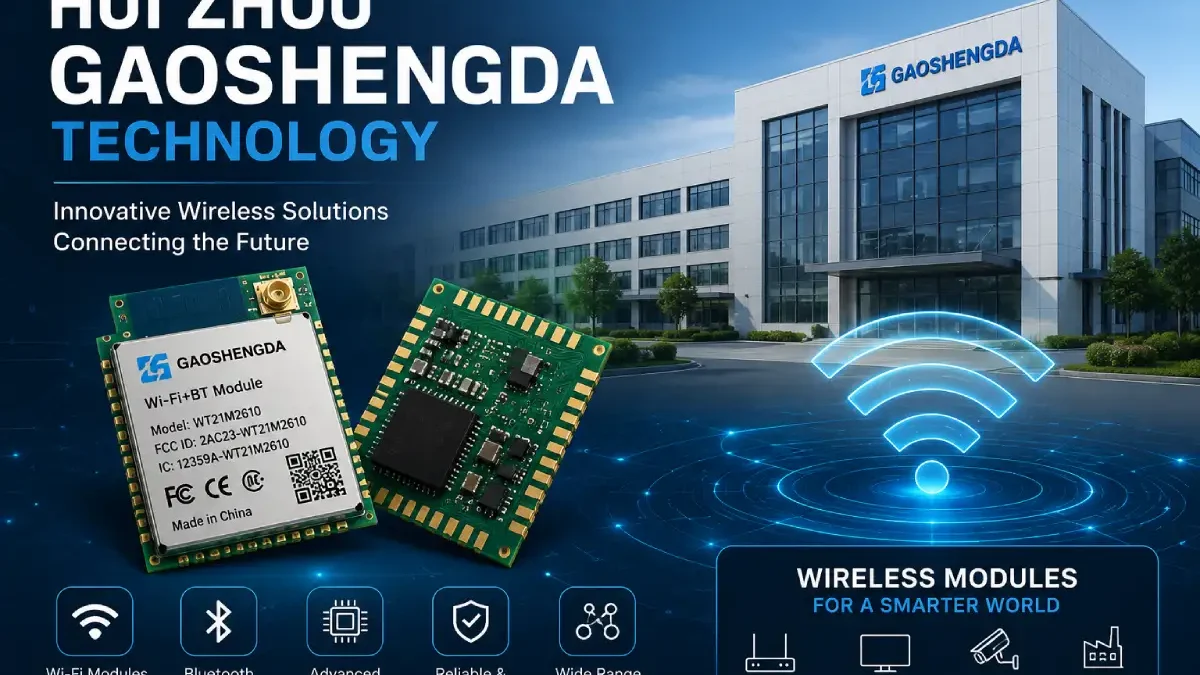
If you have ever logged in to your router to review the list of connected devices, or tried to find technical information about a smart device and come across the entry “Hui Zhou Gaoshengda Technology Co., Ltd.”, you might have wondered what that represents.
The name may seem unfamiliar, especially if the device you purchased is from a completely different brand. In many situations, however, the explanation is straightforward: Hui Zhou Gaoshengda Technology is a technology manufacturer specializing in wireless communication modules and networking hardware.
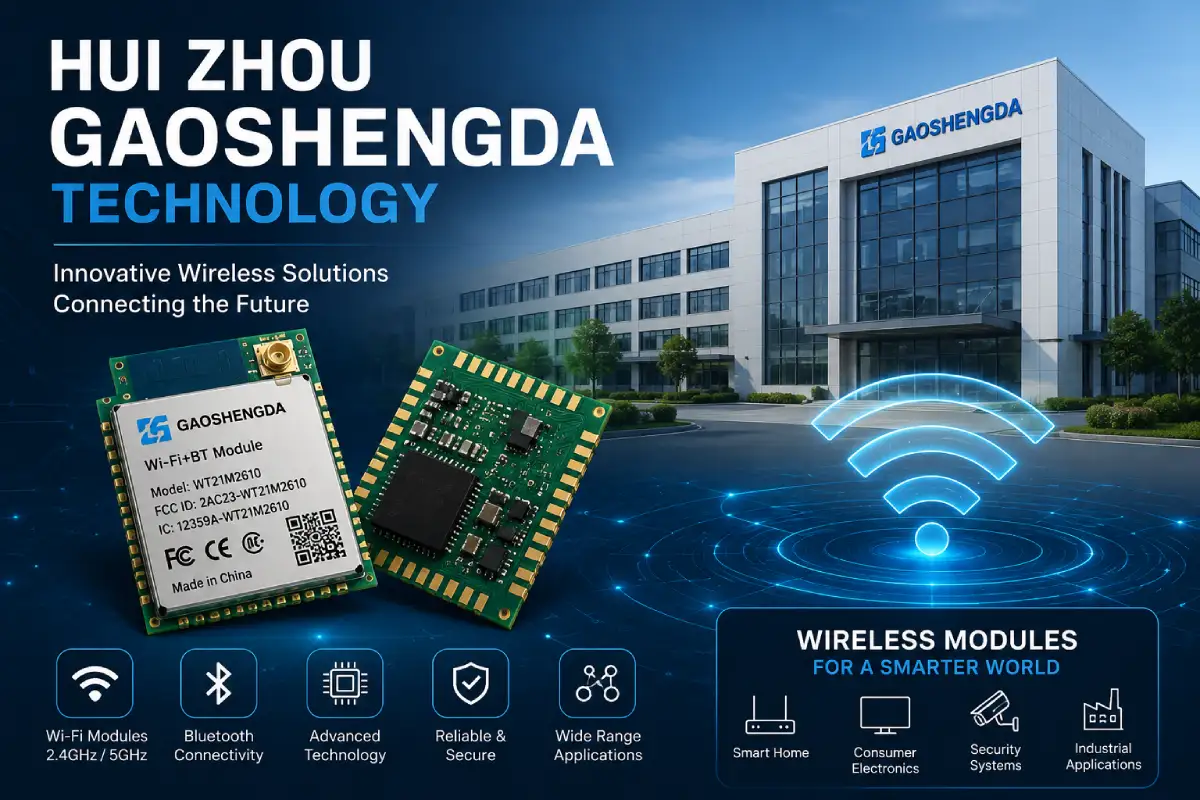
According to readily available regulatory and technical documentation, the company has manufactured Wi-Fi and Wi-Fi/Bluetooth modules used in electronic devices. The documented modules have used standards up to 802.11b/g/n, with 802.11ac more recently also found in FCC documents linked to the company, along with Wi-Fi/Bluetooth equipment.
The article below explains what this company name refers to, why it may appear in network information, the services it provides, and what you should know to ensure the device on your network really belongs there.
Table of Contents
What Is Hui Zhou Gaoshengda Technology?
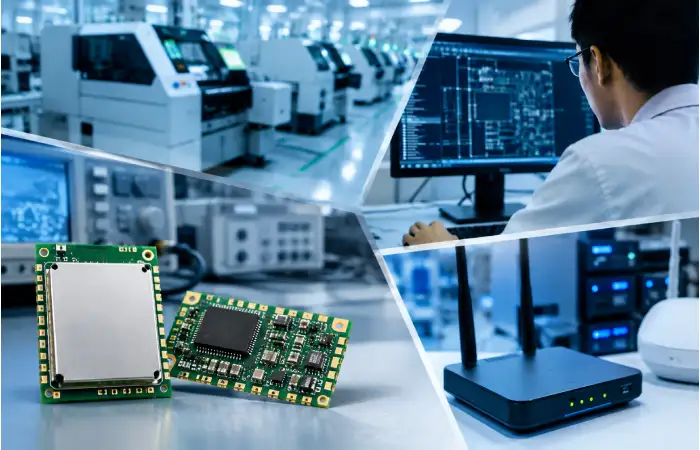
Gaoshengda Technology is a China-based Tech Manufacturer. Hui Zhou Gaoshengda Technology Co. Ltd., based in Huizhou, Guangdong, China, describes itself in its product documentation as a manufacturer and developer of wireless communication modules. A wireless module is a small electronic component that provides other devices with wireless communication capabilities.
Instead of fabricating a Wi-Fi radio from the chip level up, electronic device makers might use off-the-shelf modules when making smart devices, network appliances, TVs, and set-top boxes.
Some of these manufacturers often don’t get direct visibility in the consumer’s mind because they don’t apply their brand names on the finished product the way a consumer-facing company does. For example, Gaoshengda’s WT21M2610 appears in documentation for an 802.11b/g/n Wi-Fi and Bluetooth wireless module.
Why Does Hui Zhou Gaoshengda Technology Appear on My Wi-Fi?
This is most likely why the name pops up. A router might use the hardware details of connected devices to display the manufacturer’s name. In this case, the actual retail brand name is often replaced with that of the chip maker.
For instance, a smart TV that is sold under Brand A may have a Wi-Fi chip made by Gaoshengda, and the name displayed as part of connected devices would instead refer to the latter.
This should not automatically be interpreted as someone named Hui Zhou Gaoshengda logging in from a different computer.
What Does a Wi-Fi Module Do?
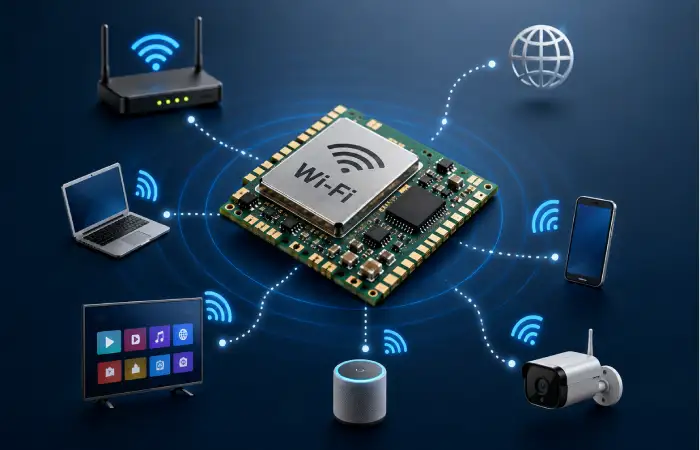
A Wi-Fi module is basically a wireless communication portion of an electronic device. The module’s purpose is to permit the host device to communicate with a wireless router/access point. Based on how the module is implemented, it may perform tasks like:
- Wireless transmission and reception
- Network authentication
- Communication with the device’s processor
- Wireless security functions
- 2.4 GHz or 5 GHz connectivity
- Bluetooth communication on combination modules
- Data transfer between the device and a network
Gaoshengda documentation illustrates how these modules can vary considerably. One documented module, for example, supports 2.4 GHz and 5 GHz Wi-Fi with 1×1 wireless operation, while another supports dual-band 2×2 Wi-Fi and Bluetooth.
Hui Zhou Gaoshengda Technology vs. a Consumer Electronics Brand
One of the easiest ways to understand the company is to separate component manufacturing from consumer branding.
| Feature | Hui Zhou Gaoshengda Technology | Consumer Device Brand |
| Main role | Technology/component manufacturing | Sells finished products |
| Common connection | Wi-Fi and wireless modules | TVs, routers, appliances, computers, etc. |
| Name seen by consumers | Sometimes visible in technical/network information | Usually printed on the product |
| Product relationship | May supply internal hardware | May integrate components from suppliers |
| Wireless technology | Wi-Fi and Wi-Fi/Bluetooth modules | Depends on the finished product |
This is why seeing the manufacturer’s name does not necessarily tell you which product in your home is using the component.
What Kind of Technology Does Gaoshengda Produce?
Public technical filings reveal some information about the company’s wireless technology. While the earlier filings document modules compliant with IEEE 802.11 b/g/n specifications, there are also documented devices that support dual-band 802.11 a/b/g/n/ac connectivity. More recent filings to the FCC include Gaoshengda as the applicant for Wi-Fi and Wi-Fi/Bluetooth devices.
An FCC filing dated December 11, 2026 describes model number DCT1VR2611 as a dual-band 2.4 GHz/5 GHz Wi-Fi 2×2 MIMO wireless device with Bluetooth connectivity.
The company has a range of wireless technology on record rather than relying on a single router format.
What Is 2.4 GHz Wi-Fi?
2.4 GHz Wi-Fi is a wireless frequency band commonly used by routers and connected devices.
Its major advantage is range. Signals at 2.4 GHz can generally travel farther through walls than higher-frequency Wi-Fi signals, although real-world performance depends on the building, interference, antenna design, router, and other conditions.
Many smart-home products continue to use 2.4 GHz because compatibility and range can be more important than achieving the highest possible throughput.
Several Gaoshengda module specifications include 2.4 GHz Wi-Fi support.
What Is 5 GHz Wi-Fi?
Wi-Fi in the 5GHz band uses a higher frequency band and can achieve better wireless speeds but at the cost of shorter range and poorer performance in overcoming obstacles such as walls. With the availability of a dual-band device, the device is capable of using one band, the other band, or both simultaneously.
Gaoshengda’s dual-band module data sheet indicates support for dual-band Wi-Fi, which includes the 2.4GHz band and the 5GHz band.
What Does 1×1 or 2×2 Mean?
You may encounter terms such as 1T1R or 2T2R in technical documentation.
These describe the number of transmit and receive radio paths.
1T1R means one transmit path and one receive path.
2T2R means two transmit paths and two receive paths.
Multiple radio paths can be used with technologies such as MIMO, which can improve wireless performance when the network, antennas, and environment support it.
For example, Gaoshengda’s D3KR1001 documentation describes a 1×1 dual-band Wi-Fi module, while other company documentation describes 2×2 designs.
What Is MIMO?
MIMO, or Multiple Input Multiple Output, is a wireless technology that uses multiple antennas or radio paths to transmit and receive data.
Instead of treating wireless communication as a single stream, MIMO can use multiple spatial streams under appropriate conditions.
This is particularly useful in modern Wi-Fi equipment because it can increase capacity and improve the efficiency of wireless communication.
Although a device may feature a 22 module, it is unlikely to constantly run at that speed. Router capabilities, the wireless protocol, channel environment, interference issues, signal strength, software used, as well as the capabilities of the other device, influence performance.
Does Seeing Gaoshengda Mean My Network Has Been Hacked?
Not by itself.
Seeing “Hui Zhou Gaoshengda Technology” in your router’s device list is not sufficient evidence that your Wi-Fi network has been compromised.
The first thing to do is compare the router’s connected-device list with the electronics you actually use.
Think about devices such as:
- Smart televisions
- Streaming boxes
- Wi-Fi cameras
- Smart speakers
- Wireless printers
- Set-top boxes
- Smart appliances
- Older computers
- IoT devices
- Wi-Fi adapters
If one of these devices uses a Gaoshengda wireless component, your router may associate the manufacturer name with that device.
A more useful security question is not simply “Why does this manufacturer appear?” but “Can I identify every device currently connected to my network?”
How Can You Identify the Device?
Start with your router’s administration page.
Look for a section called something similar to:
Connected Devices, Clients, Attached Devices, Device List, or Network Map.
Then compare the information shown there with the devices in your home.
Pay attention to:
- Device name
- MAC address
- IP address
- Connection type
- Manufacturer information
- When the device was last active
If you recognize the device, there is usually no reason to be concerned simply because Gaoshengda appears as its manufacturer.
If you cannot identify it, temporarily disconnect your own smart devices one by one and refresh the router’s device list. This can help you discover which product corresponds to the unknown entry.
Why Manufacturer Names Can Be Confusing
Modern electronics are rarely made entirely by one company.
A single smart television, for example, may contain components supplied by several different manufacturers:
- Display manufacturer
- Processor manufacturer
- Memory manufacturer
- Wi-Fi module manufacturer
- Bluetooth chipset supplier
- Power-management component supplier
- Storage supplier
The brand on the front of the product represents the finished device. It does not necessarily represent every component inside it.
That is why a manufacturer name that looks unfamiliar can appear in network tools.
Gaoshengda and Wireless Standards
Another interesting part of Gaoshengda’s technical history is the range of wireless standards documented in its products.
| Wireless technology | General purpose | Example in Gaoshengda documentation |
| 802.11b | Older 2.4 GHz Wi-Fi | Documented in several modules |
| 802.11g | Older 2.4 GHz standard | Supported by earlier modules |
| 802.11n | Improved Wi-Fi performance | Supported by multiple modules |
| 802.11ac | Faster 5 GHz Wi-Fi | Documented in dual-band modules |
| Bluetooth | Short-range wireless communication | Included in combination Wi-Fi/BT modules |
These standards represent different generations of wireless networking. Actual performance varies according to the particular module and the complete device in which it is installed.
Is Hui Zhou Gaoshengda Technology a Router Company?
It is better to think of Gaoshengda primarily as a wireless technology and component manufacturer, rather than assuming that every device associated with its name is a standalone router.
Its publicly available documentation contains Wi-Fi modules, Wi-Fi/Bluetooth combination modules, and related wireless hardware.
A module can be incorporated into a much larger product. The finished product may be marketed under another company or brand.
This distinction explains many of the confusing manufacturer names found in router administration pages.
What Should You Do If You See This Name?
There is no need to panic.
Follow a simple process:
First, identify the device.
Check the connected-device list and compare it with your television, phone, computer, printer, camera, and smart-home equipment.
Second, check the MAC address.
The MAC address can help distinguish one network device from another.
Third, disconnect suspected devices.
Turn off one smart device at a time and refresh the router’s list.
Fourth, secure your Wi-Fi.
Use a strong Wi-Fi password and modern security settings supported by your router.
Finally, investigate genuinely unknown devices.
If a device remains unidentified after checking everything you own, change the Wi-Fi password and reconnect your trusted devices.
The Bigger Picture: Why Wireless Module Manufacturers Matter
These Chinese Companies Build the Invisible Tech In Every Connected Gadget. Companies like Gaoshengda labor in the back channels of the connected-device business. Consumers notice the brand printed on a flat-screen TV or on a wireless router, security camera, or kitchen appliance. But behind the label and the plastics lies a hardware and chip stack that may include dozens of specialized devices helping make it smart.
Wireless modules – essential for connecting a gadget wirelessly to a network – fall into this category.
Your smart TV wouldn’t stream video over Wi-Fi, a smart appliance wouldn’t log into a cloud server, or a smart device would be little more than a decorative paperweight without a tiny wireless module.
Final Thoughts
Hui Zhou Gaoshengda Technology Co., Ltd. is associated with the manufacture of wireless communication technology, including Wi-Fi and Wi-Fi/Bluetooth modules. Public technical and regulatory records document a range of products covering different Wi-Fi standards and wireless configurations.
If you see the name Hui Zhou Gaoshengda Technology on your Wi-Fi network, the most likely explanation is that one of your connected devices has wireless hardware manufactured by the company.